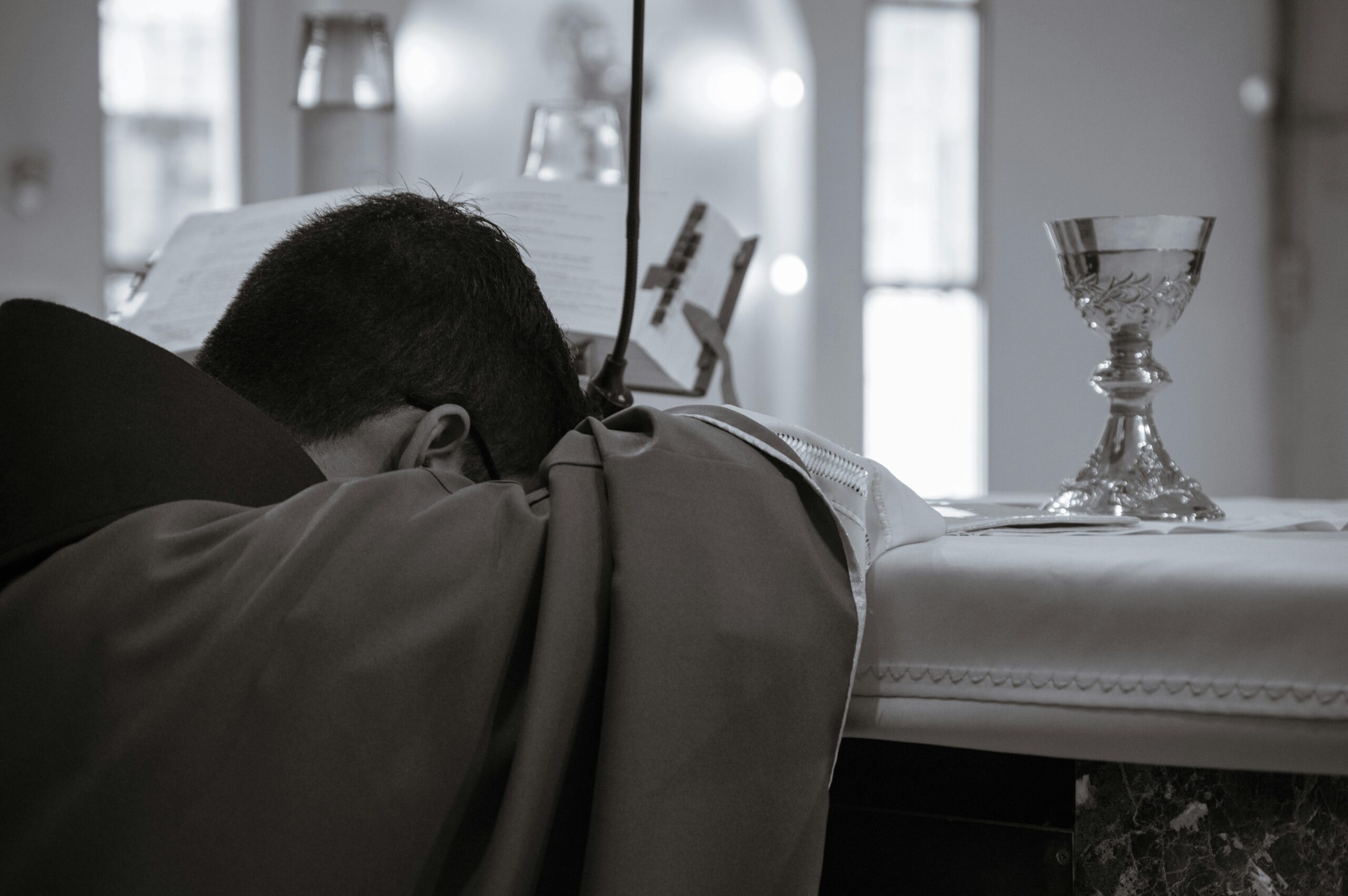
1) Mortification
There are organic processes that the Holy Spirit works within you to bring you to immortality, and the first is mortification. The greatest enemy of immortality is the flesh. The word “immortality” means perfect and without corruption. When we fell, that was when we assumed the name “mortals”—it means we became creatures of corruption.
The gospel came to remove that corruption from us. The first way God begins this journey is through mortification. What the Holy Spirit does is deaden the promptings of the flesh. If those promptings remain, you can never grow into immortality. The word “mortification” is the same root from which the word “mortuary” is derived. When someone dies, you refrigerate the body to stop decomposition—you freeze the cells. While the cells remain frozen, decomposition is impossible. That is exactly what the Holy Spirit does in you.
You may have lust for worldly things, lust for forbidden pleasures, or lust for anything that is not God. When the Holy Spirit comes, He freezes those lusts so they can no longer find expression: The appetite dies. If the appetites of the flesh are not mortified, immortality cannot be realized.
Romans 8:13 “For if you live according to the flesh, you will die; but if by the Spirit you put to death the misdeeds of the body, you will live.
When God’s dimensions are installed in a person, the Holy Spirit goes to work. We are meant to function by life, ruling over death. But there is a reverse mechanism: if we live according to the flesh, we shall die. A man who is meant to carry life and immortality can still die if he lives according to the flesh. But if, by the Spirit, we put to death the deeds of the body, we will live.
Many Christians do not understand that Christianity is not primarily about rules. Christianity is about giving life and killing the appetites of the flesh. When the desires of the flesh are mortified, the things that should not rule will no longer dominate your lifestyle. It is not enough to dress piously; if the desire to be naked or indulge in sin still exists, then you have a serious problem. That means you have packaged your problem, and it will remain with you for a long time.
It is not enough to appear holy, to be zealous for God, and to show love outwardly, while lust rages inwardly. Cry for help quickly, because how you look outwardly is not as important as how you are inwardly. The outward is meant to be a byproduct of the inward. The reason the outward matters is because it reflects the inward. But if you have not worked on the inward and only package the outward, you are in trouble. It is like a cup that is dirty on the inside but clean on the outside—you cannot use it. What the Holy Spirit wants to do is deal with the inward first. When the inward is transformed, the outward will naturally reflect it.
The way the Holy Spirit mortifies flesh is by addressing your appetites—and this is not about rules; it is about intimacy. That is why Paul said, “The grace of our Lord Jesus Christ, the love of God, and the communion of the Holy Spirit be with you.” Without intimacy, you can never mortify the flesh; It is impossible.
The Holy Spirit mortifies flesh by giving you prescriptions that are consistent with your own condition. Two people may struggle with the same issue—say, lust or smoking—but their prescriptions may be different. For example, He may tell you to worship continually, while He tells me to fast. If I look at you worshiping and think, “Oh, I’ll just do that to overcome my habit,” I may worship God faithfully, and He will receive glory, but the appetite may actually grow stronger. In fact, after a worship program, I may desire it even more.
The Holy Spirit works on those who approach Him; He gives the prescription that is specific to them. Your protocol is different from mine. Ten people may struggle with lust, and He may tell one to pray, another to worship, another to fast. If they obey, over time, the appetite will die. As a preacher, I may tell everyone to pray, fast, and worship because all of that is spiritually beneficial. But for true mortification, you must have a deep relationship with the Holy Spirit so He can give you the prescription that is uniquely for you.
If you have not come to the point of consecration, you can never experience mortification, because consecration is the specific instruction the Holy Spirit gives you to keep. You can have dreadlocks, and it may not affect your power at all. It was only in Samson’s case that dreadlocks affected his power. So, the secret of power is not dreadlocks, but the secret of Samson’s power was his dreadlocks—because for him, it was a consecration. When we speak of consecration, we are not referring to fasting, worship, or prayer. All of these are general Christian practices. Consecration refers to the specific command the Holy Spirit gives to you personally. A person who does not have intimacy with the Holy Spirit cannot have consecration. And it is only when consecration is established that the flesh can be mortified. When the flesh is mortified, the second thing that happens is that the body is quickened.
2) Quickening
Romans 8:11 “But if the Spirit of him that raised up Jesus from the dead dwell in you, he that raised up Christ from the dead shall also quicken your mortal bodies by his Spirit that dwelleth in you.
When we talk about the flesh, we are referring to the fallen nature. Your flesh is not your body. If you practice penance in a harmful way, you will only end up hurting yourself. Some people climb mountains on their knees—you only destroy your kneecaps; you do not deal with the problem. Do not damage your body. Your body is merely the vessel through which the flesh expresses itself. The flesh itself is not a fallen nature.
Some people even apply chemicals to their eyes so they will not lust after women. You may go blind, and the appetite will still be there. So, do not punish your body. Allow the Holy Spirit to mortify your flesh. Your body is meant to be quickened, because it is the temple of the Holy Spirit. However, the body cannot function effectively as the temple of the Holy Spirit unless the flesh is mortified.
Christians who pray and walk with God will come to a point where they begin to notice impulses in their bodies. We walk by faith and not by sensory perception, but when you become intimate with God, He allows your body to partake in certain prophetic signals. These are the “quickenings.” There are people who, when their body is quickened, perceive a movement as if an insect is walking on their head. When that movement happens, whatever they are thinking at that moment becomes a word of knowledge. They may look at someone and hear a name—Susan—and ask, “Who is Susan?” only to find that the person’s name is Susan.
There are others for whom the quickening manifests as a stirring of faith. They suddenly feel that nothing is impossible. When they hit that frequency, even if a leg were cut off, they would speak to it and it would grow back. This is quickening. All of these are protocols of immortality.
Have you heard of the ministry of Oral Roberts? Oral Roberts used to have a sign in his right palm. When he preached to a certain level, heat would come into that palm. Once it began to burn, no matter the disease, people would come to him, and he would place that hand on them. Kenneth Hagin also shared that when his thumb became numb, anyone he laid hands on at that time was most likely to be healed. He said that when the numbness came, he would quickly move along the line, touching people, because that numbness was a signal he was working with.
These were people with quickened bodies—and they are not the only ones. The problem with many of us is that we are not sensitive in our walk with God, so we cannot discern these things. This journey is personal, from one individual to another. This is why Christianity goes beyond church activities and attendance; it is a personal walk with God. Church is important—it is a training ground that adds value to your spiritual life. I am not saying we should despise church, but if you do not have a personal walk with God, church attendance alone becomes ineffective. What I am teaching you now—some people may never practice it. When it happens to them, they may say, “That is what the man of God was saying; so, it is true,” and they will stop there. Such people will never grow into what God intends them to become.
For some of us, our hands are quickened, because the work God has committed to us will be perfected through our hands. For others, it is their eyes; for others, their minds. A person may simply sit down and begin receiving inspirations on how to invest money. He starts drawing ideas, and those ideas become global designs. You begin to wonder, what kind of mind is this? It is a quickened mind. This is where dominion begins. If you are not quickened, you can never exercise dominion. No matter how many Scriptures you quote, until you are quickened, there will be no dominion. When you are quickened, different aspects of your makeup become tools in the hands of God. When you move beyond this level, you come to the third level of immortality, which is the level of transformation—the migration from a fleshly mindset to a spiritual mindset.
3) Transformation
For some of us, it is not that we are sinful; it is that we are full of logic. When something happens, our immediate response is to explain it by Newton’s second law of motion or the law of universal gravitation. The mind becomes choked with logic. So, when we speak of transformation, sin is part of it, but it goes beyond sin. Albert Einstein said that we do not despise or deny facts, but we recognize that there are realms beyond facts. God must bring us to that point where we can believe realities that exist beyond the realm of facts—and only the Word of God can accomplish that.
Romans 12:1-2 Therefore, I urge you, brothers and sisters, in view of God’s mercy, to offer your bodies as a living sacrifice, holy and pleasing to God—this is your true and proper worship. Do not conform to the pattern of this world, but be transformed by the renewing of your mind. Then you will be able to test and approve what God’s will is—his good, pleasing and perfect will.
You need the Word of God to renew your mind; it is a journey toward immortality. You know that when you have a headache, you go to see a doctor, and based on the diagnosis, drugs are administered. If they determine it is stress-related pain, they may give you paracetamol. If paracetamol does not work, they prescribe stronger painkillers. When the painkillers become excessive and dependency begins to develop, they may suggest a CT scan. But now you are reading the Word of God. You understand that although what the doctor is seeing is correct—and you should not despise it—there is a realm beyond that which says, “You shall lay hands on the sick, and the sick shall recover.” At first, this may not make sense to you. But as you pray and meditate on the Word of God, that reality becomes stronger in your mind, and suddenly, healing manifests.
Then, when someone is sick, before you say, “Go and see a doctor,” you say, “Be healed.” You will realize that you have moved from one realm to another—not recklessly, but because God has prepared you. Do you know what it means to say, I can live above corruption, and I can live forever? This is not something the natural mind can easily process. You have seen too many people die and too many people struggle. It would be impossible for the mind to accept it instantly. That is why God takes us on a journey—carrying us step by step—until He brings us to the destination. People will tell you, “You have to do this business or that business to succeed,” and there are facts and statistics to support it. But while you are asleep, an angel comes to you and says, “Do this business instead.” When you wake up, it is not consistent with what your friends were saying or with the conclusions of your research.
For one week, you struggle, doing what your friends advised, and you realize you are not succeeding. Then you decide to do what the angel told you to do, and suddenly you experience a breakthrough. You may not realize at first that although what your friends said was factual—because data and statistics supported it—there is a realm that cannot be captured in scholarly documents. A point comes when you begin to explore that realm. So even when you see something supported by facts, you still check heaven and say, “Lord, this is what is predominant, but what are You saying?” And a point will come when, as you engage consciously, you begin to receive feedback. You then realize, “Oh, this realm does not just come to you—you can go there.”
Do you remember those days when we thought the prophetic only happened when someone was sleeping—when God wanted to speak, He would say something in a dream, and the next day, during a meeting, the person would share what God revealed? Then a point came when we began to prophesy without dreams. Angels could walk with men, and people were amazed. It was a dimension that had not yet been widely known—until certain men began to model it. And when you go back to Scripture, you see that people like Elijah operated this way. A point will come when you begin to consciously engage that realm. You are going for an interview and you have studied all the books you need to study, but two hours before the interview, you lock yourself away and begin to pray in tongues. You do this because you know there are certain words—certain expressions—that will make the difference in that interview.
What you are doing is preparing your tongue to receive them. When you enter the interview, you begin to say things you never heard before and never studied. And you are not surprised, because you know that while you were speaking in tongues, you were sharpening your tongue. You already expected these things to happen. This means you have begun a journey into the realms of renewal. You have come to a point where the spirit realm is more real to you than the natural realm. And when you reach this point, you are close to immortality—because the next level from here is the level of transfiguration.
4) Transfiguration
2Corinthians 3:18 But we all, with open face beholding as in a glass the glory of the Lord, are changed into the same image from glory to glory, even as by the Spirit of the Lord.
The word “transfiguration” is metamorphosis—the same way an egg becomes a butterfly. When you look at the egg, there is nothing in it that resembles wings. But when transfiguration happens, the egg suddenly has wings; it has colors; it has eyes. And you begin to wonder, Where did they come from? These are the powers of transfiguration. When a man is transfigured, things that were not there suddenly appear. That is when you discover that you are walking on the earth as an immortal.
The early Church addressed John as John the Divine because he entered a level where he could not die. They gave him poison, and it did not kill him. They threw him into boiling oil, and when the oil finished boiling, he came out. They tied him to the back of a chariot and dragged him around the city; he had no injuries. He stood up and brushed off the dust. When they saw that this man could not be killed, they sent him to a place called Patmos. Patmos was an island of death. Since they could not kill him with boiling oil or by dragging him through the streets, they thought isolation would kill him—perhaps through depression. But while he was there, he said, “I was in the Spirit on the Lord’s Day.” His entire experience in Patmos became a single day. From Patmos, which was meant to be an island of death, he found the gate of heaven. When you are transfigured, you are able to bring heaven and earth together. No one can kill you anymore. You become an immortal among men.
This is the realm where men like Elijah entered. The day Elijah was to depart, it was not a surprise to him. He told Elisha plainly, “Today I will be taken.” These were mysteries that could not be answered in that generation, but a transfigured man knew certain things. I once thought salvation was only possible after Jesus came, died, and resurrected. But I began to see that there were gates in the spirit realm that some men explored long before then. This is not merely doctrine; it is a journey of intimacy.
Jesus himself said, “Abraham your father saw my day and rejoiced.” And the people replied, “You are not yet fifty years old—how did Abraham see you?” Jesus answered, “Before Abraham was, I AM,” because the Lamb was slain before the foundation of the world. This means that while some of us met Him when He came into time, others encountered Him before the foundation of the world. Those men accessed Him in that eternal realm. Others, who did not have that depth of intimacy, had to wait for Him to come into history.
Do you think Elijah simply vanished and reappeared on the Mount of Transfiguration by coincidence? Elijah stood there with Moses, speaking with Jesus about what would happen to Him in Jerusalem—His death, burial, and resurrection. That means Elijah knew. He had knowledge beyond his generation. When Elijah reached the moment of his departure, he asked Elisha, “What do you want?” Elisha replied, “Give me a double portion of what you carry.” Elijah said, “You have asked a difficult thing, but I will tell you how to get it.” These men knew secrets in God. These were not things handed out casually.
One thing about the patriarchs is that they knew where human ability ended and where God’s ability began. We often quote, “Flesh and blood cannot inherit the kingdom,” yet Scripture tells us that someone was caught up to heaven alive. That means that somewhere along the line, transfiguration took place. There are dimensions in glory where mortality gives way, and flesh yields to the power of God. These are not theories; they are realms that were accessed by men who walked deeply with Him.
Immortality swallowing mortality is what every Christian is meant to walk in. We may be at different levels, but this is what truly defines our Christianity—how much of our immortal dimension is being expressed. There is a level you arrive at where your words carry authority, where someone is about to die and you say, “No,” and death does not prevail. That is Christianity. If all of us are helpless, and we are all pursuing the same things the godless are pursuing, then what we are practicing is not Christianity but religion. The proof that we possess something the world should desire is this: where they are frustrated, we should be able to bring change; where they are hopeless, we should be able to show a way forward. We should be able to demonstrate that life does not end where experience ends—that there is a realm beyond.
Unfortunately, many of us are not journeying deeply in God, and so we fail to manifest what we truly carry.